Scan Here, Share Everything: The Invisible Ledger Behind Every Event QR Code
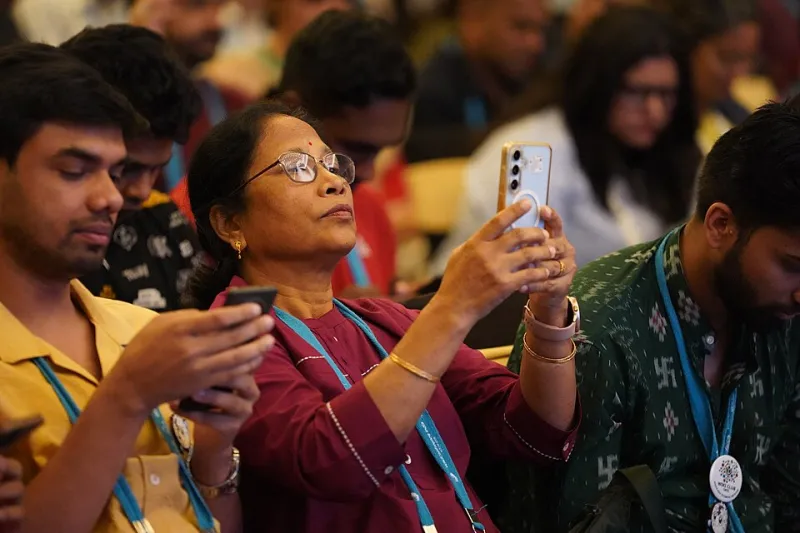
Photo: Gangulybiswarup, CC BY 4.0, via Wikimedia Commons
You hand your phone to the attendant at the venue door, the QR code on your ticket glows green, and you walk inside. Nothing about the moment feels like a transaction. Yet in the span of that scan, a small constellation of data points has already been recorded: the time, the approximate location, the device type, the operating system, sometimes the IP address, and — depending on the system — an identifier that may persist well beyond the evening.
Multiply that moment across a flight check-in, a parking garage, a restaurant menu, and a raffle entry, and the outline of an entire night — perhaps an entire life — begins to resolve.
What Actually Happens Between Scan and Destination
A QR code is not a link you click; it is a link your camera executes. When your phone parses the pattern, it typically resolves a shortened or redirected URL, and that redirect is where the accounting begins.
The destination server can log your IP address and user-agent string. The redirect chain can pass through analytics platforms and ad-tech intermediaries, each of which may append or read identifiers. If the QR system is tied to an app you have installed or an account you have logged into, the scan can be stitched to your real identity. Dynamic QR codes — the kind used for tickets and boarding passes precisely because they can be invalidated or updated — are, by design, live endpoints. Unlike a static code printed on a poster, a dynamic code can record every scan individually, timestamped and attributed.
In other words: the convenience you experience as a customer is also, in many systems, a check-in that says this specific device was here, at this moment, responding to this specific prompt.
Who Assembles the Touchpoints
No single company necessarily holds the whole picture, but the picture gets assembled anyway. Event-ticketing platforms know which shows you attend. Airline and transit systems know your movement corridors. Restaurant QR-ordering services know where and when you eat, and frequently what you ordered. Parking operators know the geography of your routine.
These datasets become more valuable — and more invasive — as they are combined. Advertising id networks, data brokers, and marketing platforms specialize in exactly this kind of stitching: joining anonymous-looking touchpoints into persistent profiles using device identifiers, hashed email addresses, or IP correlation. Under the patchwork of US privacy law — comprehensive statutes in states like California, Colorado, and Connecticut, with far weaker protections elsewhere — much of this activity remains lawful, particularly where the data is framed as "operational" rather than marketing-oriented.
The result is a tracking network that no one opted into consciously. Americans simply started scanning, because during the pandemic the QR code became the least friction-laden way to do nearly anything in public.
The Risks Beyond Profiling
Profiling is the slow harm. The faster ones deserve equal attention:
- Tampered codes. Researchers have repeatedly demonstrated that stickers placed over legitimate QR codes can redirect scanners to credential-harvesting pages. The FBI has issued public warnings about exactly this technique.
- Over-privileged apps. Some QR-triggered experiences push users to download apps that request location, contacts, or notification access far beyond what the interaction requires.
- Link leakage. Dynamic QR URLs frequently embed tokens. Screenshot a boarding pass and post it online, and anyone who captures the code may be able to pull up your itinerary.
Scanning Without Surrendering
None of this argues for abandoning QR codes — that ship has sailed, and in many venues there is no alternative. It argues for scanning with intent.
Preview before you commit. Most modern phones display the destination URL when the camera recognizes a code. Read it. A garbled shortened link on a parking sign is worth a second of suspicion.
Prefer your browser to new apps. If a QR code demands an app download for a one-time interaction, ask whether the convenience justifies a permanent data relationship. Often it does not.
Use a browser with tracking protection. Privacy-focused mobile browsers strip many of the identifiers and redirect trackers that default browsers pass along.
Avoid scanning on public Wi-Fi. A venue's open network makes your traffic easier to correlate. Cellular data, or a reputable VPN, severs that linkage.
Treat public QR codes like ATMs. If a sticker looks recently applied, misaligned, or sits over another code, do not scan it. Report it to the venue.
Audit the accounts behind the codes. Ticketing, transit, and restaurant apps accumulate location histories. Periodically reviewing and deleting that history — where the service allows it — shrinks the ledger retroactively.
The Square Is a Sensor
The QR code was invented in 1994 to track automobile parts, and in a sense it never stopped doing that job. It has simply been pointed at people. The square itself is neutral; the systems wrapped around it are not.
The practical takeaway for American consumers is a matter of calibration, not paranoia. Scan when it serves you. Pause when it does not. And remember that every convenient square is also, quietly, a sensor — one that logs your presence, your timing, and your trajectory, whether or not you ever think to ask what it recorded.